
What Is TMJ? The Temporomandibular Joint Explained
"TMJ" is shorthand people use for two different things: the joint itself, and the disorder affecting it. The joint is the temporomandibular joint. The disorder is more precisely called TMD — temporomandibular disorder. Most people arrive using the first term to describe the second, which is fine, but the distinction matters once you start reading about treatment.
The joint is more complicated than a hinge
Your jaw joint both rotates and slides. For roughly the first inch of opening it rotates in place; beyond that, the whole condyle translates forward along a slope in the skull. Between the two bone surfaces sits a small fibrous disc that has to move with the condyle throughout. That combination of rotation, translation and a mobile cushion is what makes the joint capable of chewing — and what gives it several distinct ways to fail.
Most problems are muscular, joint-related, or both
Broadly, TMD falls into muscle-driven pain, joint-driven problems, or a mixture. Muscle-driven pain comes from muscles that never fully release — often tied to clenching, grinding, posture or sustained stress. Joint-driven problems involve the disc, the ligaments, or the joint surfaces themselves: a disc that slips out of position and clicks back, a joint that catches, or surfaces that have degenerated over years of overload. The two feed each other, which is why treating only one usually disappoints.
Why the symptoms show up somewhere else
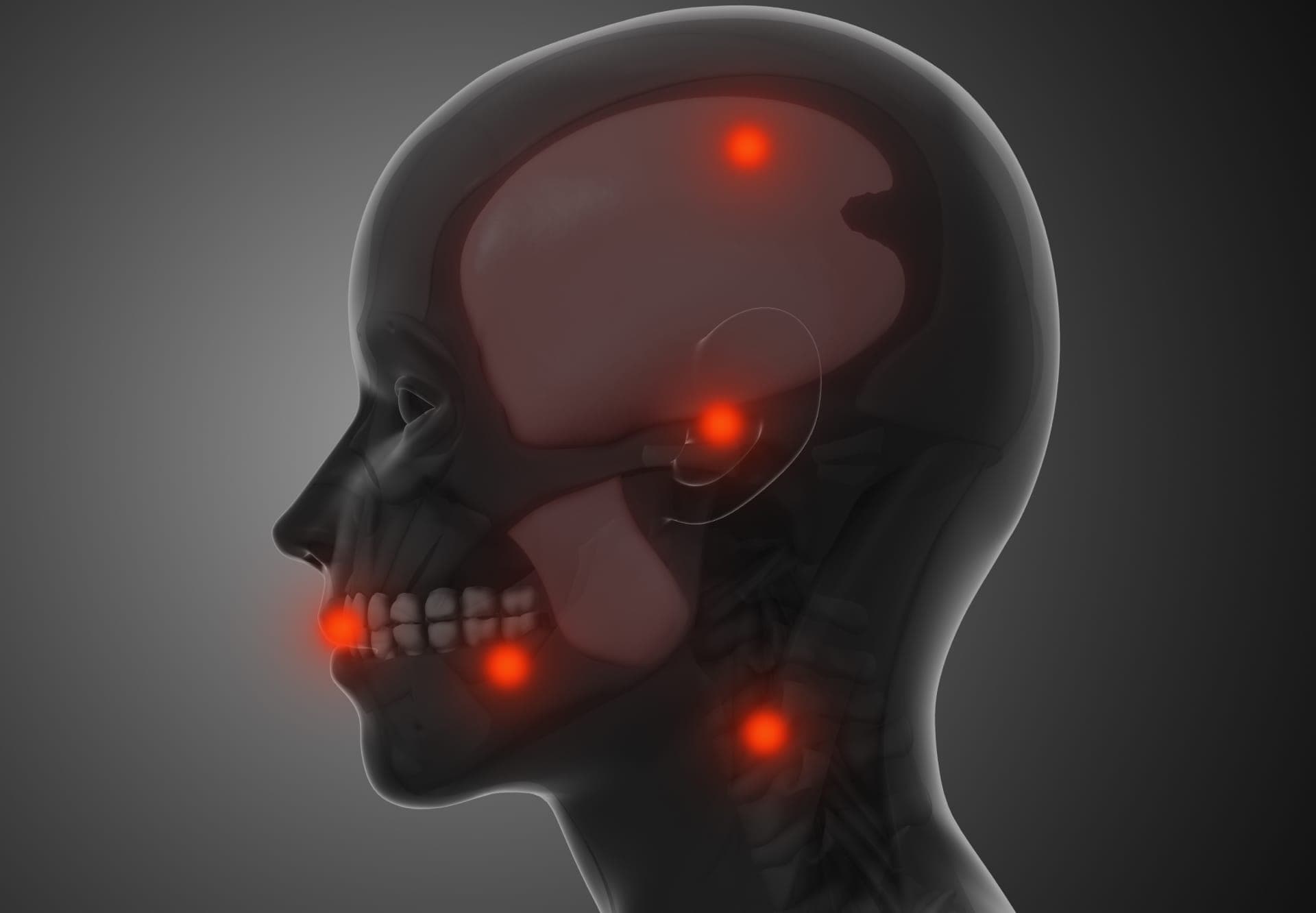
The nerve supplying the jaw joint and its muscles shares pathways with structures across the head and face. The brain is not always able to localise the source precisely, so jaw dysfunction is regularly experienced as a headache behind the eye, pressure or ringing in the ear, pain in the upper teeth, or tightness running into the neck and shoulder. This is called referred pain, and it is the single most common reason people spend years being treated for the wrong thing.
It is diagnosable
TMD is not a diagnosis of exclusion or a label applied when nothing else fits. It has defined diagnostic criteria, a physical examination that tests range, joint noise, muscle response and loading, and imaging where the joint itself needs to be seen. A proper workup should tell you which structures are involved and why — not simply that you have "TMJ".
Common questions
- Is TMJ the same as TMD?
- TMJ is the joint; TMD is the disorder. In everyday use the two are interchangeable, and no clinician will misunderstand you for saying TMJ.
- Does jaw clicking always mean something is wrong?
- No. Painless clicking with full, comfortable range is common and often needs monitoring rather than treatment. Clicking that comes with pain, catching, or a jaw that is starting to limit is a different situation and worth evaluating.
- Can TMJ problems resolve on their own?
- Some episodes settle, particularly when they follow a clear short-term trigger such as a period of stress or a long dental appointment. Symptoms that have persisted for months, or that are progressing, tend not to resolve without addressing the cause.
Not sure where to start?
Request a virtual consultation with Dr. Samadian. In-person visits are by appointment in New York.
Book An AppointmentPatients of Dr. Samadian
Written by patients treated across the Dion Health practices.
“I found myself dealing with a number of medical issues that I had no idea were so directly tied to my sense of oral wellbeing. The professionals at Dion Health helped me resolve my clenching and grinding, leading to better sleep and a more enjoyable lifestyle.”
“When I'm dealing with a run-of-the-mill dental issue—or need something more serious like an implant, bridge, or crown—I know I can trust the Dion Health network to provide me with the most advanced techniques, for results that last.”
“Showing off a glowing smile has me feeling more confident than I've ever felt in my life. Dion Health has fully rehabilitated my smile, resolving all my cosmetic issues with long-term solutions and helping me enjoy the self-esteem I deserve.”
Real patient stories
Patients Dr. Samadian has treated describe their experience in their own words.
Lindsay — TMJ patient
Olivia — TMJ patient
Chihiro — TMJ patient
Testimonials reflect the experiences of individual patients. Individual results vary.
Credentials and affiliations


Related Care
All TMJ- TMJ TreatmentHow TMJ disorders are diagnosed and treated in New York.
- TMJ SpecialistWhat separates a TMJ specialist from a general dentist.
- TMDTemporomandibular disorders — the broader diagnosis behind TMJ.
- Jaw PainAching, tightness, or pain when chewing.
- TMJ HeadachesRecurring headaches and facial tension tied to the bite.
- Night GuardsWhy a drugstore guard often makes jaw pain worse.